



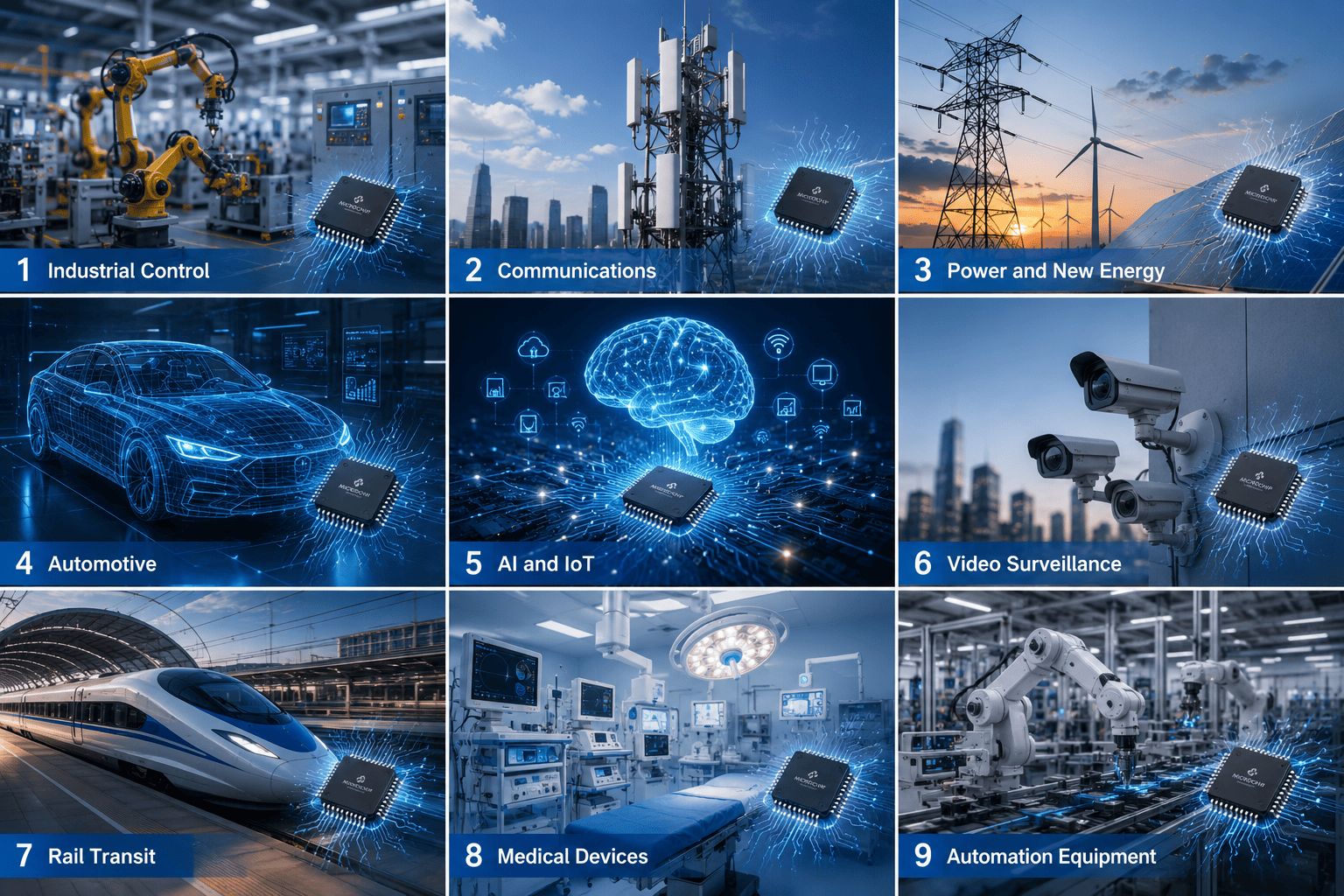
1. Industrial Control
Industrial control systems demand highly reliable and long-life semiconductor solutions to ensure stable operation in harsh industrial environments. Chips are widely used in PLCs, industrial computers, servo drives, frequency converters, human-machine interfaces (HMI), and factory automation equipment. They provide precise signal acquisition, real-time data processing, motor control, and communication functions, helping manufacturers improve production efficiency, reduce downtime, and support intelligent manufacturing and Industry 4.0 applications.
2. Communications
Modern communication infrastructure relies on high-performance semiconductor devices to achieve fast, stable, and secure data transmission. Chips are extensively applied in 5G base stations, optical communication equipment, routers, switches, communication modules, and wireless networking devices. They enable high-speed signal processing, protocol conversion, network management, and low-latency communication, supporting the rapid growth of global digital connectivity and next-generation communication technologies.
3. Power and New Energy
The power and new energy industry requires highly efficient and reliable semiconductor components for energy conversion and intelligent power management. Chips are widely used in photovoltaic inverters, energy storage systems, battery management systems (BMS), smart grids, charging stations, and wind power equipment. They provide precise monitoring, power control, protection, and communication functions, improving energy efficiency, system stability, and renewable energy utilization.
4. Automotive
Automotive electronics increasingly depend on advanced semiconductor technologies to enhance vehicle safety, performance, and intelligence. Chips are applied in engine control units (ECU), Advanced Driver Assistance Systems (ADAS), infotainment systems, battery management systems, body control modules, and electric vehicle powertrains. They enable real-time sensing, intelligent control, vehicle networking, and energy management while meeting strict automotive-grade reliability standards.
5. AI and IoT
Artificial Intelligence and the Internet of Things require intelligent semiconductor solutions capable of edge computing, wireless communication, and low-power operation. Chips are integrated into smart sensors, AI edge devices, wearable electronics, smart homes, industrial IoT gateways, and connected appliances. They support machine learning inference, real-time data collection, wireless connectivity, and intelligent decision-making, enabling more efficient and autonomous smart systems.
6. Video Surveillance
Video surveillance systems rely on powerful semiconductor devices to deliver high-definition image processing and intelligent security functions. Chips are widely used in IP cameras, network video recorders (NVR), digital video recorders (DVR), AI cameras, access control systems, and intelligent monitoring platforms. They provide image acquisition, video compression, AI recognition, motion detection, and secure data transmission for comprehensive surveillance solutions.
7. Rail Transit
Rail transit applications require highly reliable semiconductor devices capable of operating under demanding environmental conditions. Chips are used in train control systems, signaling equipment, onboard communication, passenger information systems, power supply monitoring, and intelligent maintenance platforms. They ensure accurate control, real-time communication, operational safety, and stable performance, contributing to the efficient operation of modern railway and metro systems.
8. Medical Devices
Medical equipment requires highly accurate and dependable semiconductor solutions to ensure reliable diagnosis, monitoring, and treatment. Chips are widely used in patient monitoring systems, ultrasound equipment, medical imaging devices, portable diagnostic instruments, infusion pumps, wearable health devices, and laboratory analyzers. They provide precise signal processing, sensor interfaces, data acquisition, and communication capabilities while meeting stringent medical quality standards.
9. Automation Equipment
Automation equipment relies on intelligent semiconductor technologies to achieve high-speed, high-precision, and stable operation. Chips are commonly integrated into robotic systems, CNC machines, automated production lines, motion controllers, machine vision systems, and intelligent logistics equipment. They support motor control, sensor processing, real-time communication, and precision positioning, helping manufacturers improve productivity, reduce labor costs, and accelerate the development of smart factories.


